


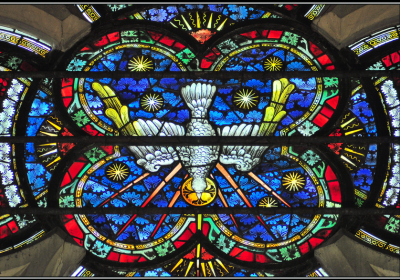
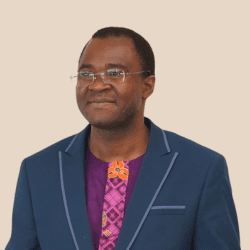
We’re delighted that our Academic Dean, Prof. Chammah J. Kaunda, was among the speakers at the Theological Studies Society of Southern Africa (TSSA) annual conference, held in Pietermaritzburg, South Africa this summer. Our Holy Spirit stained-glass window, a centrepiece in the St James and St Philip church building, is featured here because it captures something of the movement, life, and communion of the Trinity. Paired with Prof. Chammah Kaunda’s reflections on the Trinity through an African lens, it invites us to see God not only through historic depictions, but also through the rich imagery of African Christian thought.
The TSSA—one of South Africa’s oldest professional associations for theologians—encourages scholarship, research, and professional development in theology. This year’s theme, “What does Nicaea have to do with Africa? Reflections on Confessing the One Faith,” marked a significant global moment as the Church commemorates 1,700 years since the Council of Nicaea (325 CE)—the historic gathering that shaped the Nicene Creed and affirmed the divinity of Christ.
At OCMS, a number of our faculty have been engaging with the legacy of Nicaea throughout this anniversary year—speaking at conferences and publishing articles which explore what Nicaea means for the Church today across different cultures. Prof. Kaunda’s contribution at TSSA offered a distinctly African perspective through his paper, “Na-nyi-na: Decolonial Perichoresis.”
In this paper, he proposed an African reimagining of the Nicene understanding of the Trinity, drawing on indigenous Bemba concepts from Zambia. His idea of Na-nyi-na—rooted in maternal and relational ways of knowing—expresses being and belonging as deeply interconnected. It resonates with the Christian idea of perichoresis (from the Greek for “to move or dance around”), a term used to describe the loving, dynamic communion of the Father, Son, and Holy Spirit. This topic also forms part of a chapter in Prof. Kaunda’s forthcoming book, Decolonial Pentecostalism, to be published next year (available for pre-order here).
Prof. Kaunda’s approach shows how African languages and metaphors can open up fresh ways of experiencing and expressing the mystery of the Triune God—making theology feel both rooted and relevant.
We love seeing our faculty share their work at events like this, helping spark thoughtful conversations and bringing an OCMS voice into important spaces around the world.
Book Abstract:
This paper proposes a decolonial option for engaging with the Nicene Trinitarian theology by grounding its reflection in indigenous African (Bemba of Zambia) epistemological, ontological, and linguistic metaphysics. It proposes Na-nyi-na as a viable theological grammar emerging from African maternal-linguistic metaphysics that has long existed on the margins of formal theology yet remains actively embodied within indigenous communities. Drawing from the African categories of Na- (maternal origination and generation), -nyi- (ontological fertility, vital breath, and life), and -na (relational being-in-becoming, identity, and self-communication), Na-nyi-na offers an intelligible, perceivable, and visualisable analogy that resonates with the Christian doctrine of perichoresis, while remaining distinctively rooted in the lived cultural grammar of African peoples. As a maternal metaphysical category, Na-nyi-na resists both the abstraction of the Trinity’s mysteries into speculative metaphysics and their reduction to mere functional complementarity. Instead, it articulates a performative, relational vision of perichoretic indwelling, wherein ontological distinction and unbroken communion coexist without mixture, confusion, separation, or division. In so doing, it enables theological concepts to be apprehended, visualised, and enacted within culturally resonant frameworks, empowering ordinary Christians to meaningfully experience the Trinitarian faith through metaphysical and relational categories indigenous to their own traditions.
Dr. Chammah J. Kaunda