



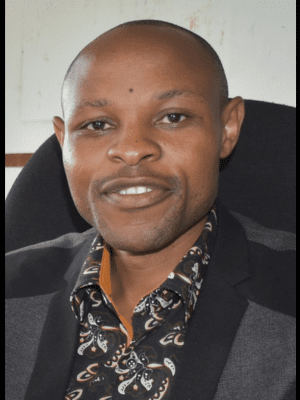
Celebrating our alumnus, Jean Musavuli, as we share his inspiring PhD journey and ground-breaking research on leadership and empowerment in the Democratic Republic of Congo.
MBL Lecture: Hoping Against all Hope: A Reflection on the past, Present and Future of Democratic Republic of Congo.
For deeper context on the challenges facing the DRC today, this MBL Lecture by David Kasali and Jean Musavuli traces the country’s painful recent history and the resilient hope shaping its future.
Jean Musavuli, now Academic Dean and lecturer of Bible and Theology at the Congo Initiative – Christian Bilingual University of the Congo (CI-UCBC), is a profound example of resilience and commitment to positive societal change. Residing in the eastern Democratic Republic of Congo (DRC) with his wife, Linda, and their three children, Jean’s life and work are deeply rooted in the complex historical and social fabric of his home country.
The DRC’s tumultuous history, from the era of King Leopold II of Belgium through the colonial period and beyond sixty years of independence, has been characterised by relentless power abuse and its devastating effects on society. It is against this backdrop that Jean has focused his academic and professional efforts, seeking ways to interpret and apply biblical teachings to the realities of contemporary Congolese society.
Jean’s approach to the Bible, particularly the book of Nehemiah, is innovative and reflective of his deep understanding of the Congolese context. He employs a postcolonial lens to explore Nehemiah, drawing parallels between the text and the DRC’s struggles. Jean sees Nehemiah not just as a historical or religious figure but as a symbol of faith and action that is highly relevant to the DRC today. He emphasizes that true faith in God should manifest in actions that seek to empower the weak rather than exploit them. This perspective is not only academic; it is a call to action for all who engage with his teachings and work.
As an alumnus of the Oxford Centre for Mission Studies (OCMS), Jean’s academic journey has been marked by a passion for exploring the intersections of faith, power, and societal change. His time at OCMS, particularly his residencies in Oxford, were pivotal in shaping his research and our perspectives. The OCMS community greatly appreciates Jean’s deep commitment to his work, which is fueled by a desire to see transformative change in the DRC.
PhD Synopsis:
In his doctoral research, Jean Musavuli delves into a postcolonial reading of the book of Nehemiah, applying it to the Congolese context to address the enduring effects of power abuse in society. He argues that Nehemiah’s story is a powerful example of how faith rooted in God can inspire action towards societal change. By using power to empower rather than exploit, Jean suggests that the lessons from Nehemiah can offer a blueprint for addressing the challenges faced by the DRC today. His work is a testament to the potential of biblical texts to inform and inspire efforts toward justice, empowerment, and transformation in postcolonial contexts.
Jean Musavuli’s journey is one of intellectual rigor coupled with a profound commitment to his community and nation. Through his teaching and research, he not only contributes to the academic field but also offers practical insights for those working towards a more just and equitable society in the DRC. His life and work bring hope and a reminder that change is possible when faith and action go hand in hand.
Full Thesis Abstract
A survey of literature on the book of Nehemiah reveals two major views which I have categorised as the Heroic View of Nehemiah (HVN) and the Critical View of Nehemiah (CVN). HVN scholars see the man Nehemiah as YHWH’s servant, successfully working for the postexilic restoration, and thus credited for the successful rebuilding of the wall and the socio-economic and religious reforms, and so consider him an example of leadership to emulate in Bible-based faith communities. However, CVN scholars see in the book a misunderstanding and misapplication of the Torah and the prophetic message. They blame Nehemiah as a failed reformer and, thus, an example not to emulate. In such a context, this thesis aims to understand what story the book of Nehemiah tells by assessing, from a postcolonial perspective, Nehemiah’s portrait and work.
The thesis suggests that the book is not about Nehemiah, the rebuilding, and the reforms, as generally held by both HVN and CVN scholarship, but about the people’s misery and reproach and attempts at resolution (through the wall project and the reforms) under Nehemiah. It shows that the portrait and work of Nehemiah entails both successes and failures, all of which are linked to Nehemiah’s hybridity – serving both YHWH and Persia. As the empire’s appointed representative, Nehemiah had the authority to conduct the reforms he envisioned for Yehud. On the other hand, however, this position would not allow Nehemiah’s reforms to free the Judeans from imperial systems of exploitation of the poor who view themselves as continuously enslaved by the kings who rule over them. In fact, the troubles of the exile continued even after the exile due, mainly, to continuous Persian dominion over the postexilic community. Therefore, Nehemiah’s efforts left the Judeans in continuous multiform misery and reproach, which might have instigated their relapse from the covenant in Neh 13.