


Kyu-sik Ahn’s book introduces English-language readers to Dasŏk Ryu Young-mo (1890–1981), a Korean Christian thinker who drew deeply upon East Asian traditions to reimagine some of the foundational concepts of Christian theology. Following the book launch, Regnum Books spoke with Kyu-sik about the challenges of translating not only words but an entire theological outlook, the response to the book in Korea, and the contribution Korean theology can make to the Church worldwide. We invite you to read his responses.
The global popularity of K-pop, K-drama, K-beauty and K-food has made Korean culture more visible than ever. Yet Korea’s contribution to the wider world extends well beyond the cultural phenomenon known as Hallyu, or the Korean Wave. Korean theologians are also bringing distinctive perspectives to the global Church—perspectives shaped by their own language, history and engagement with East Asian religious and cultural traditions.

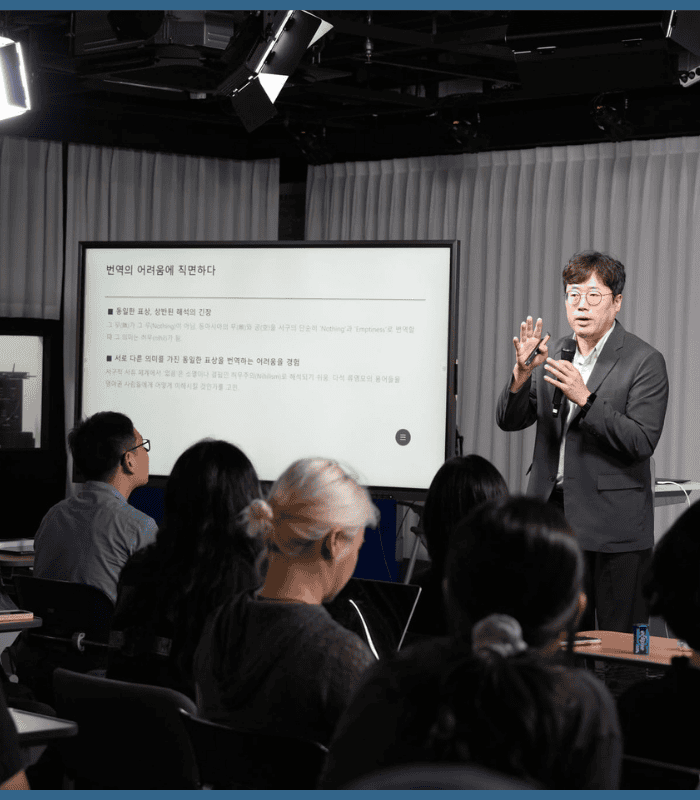
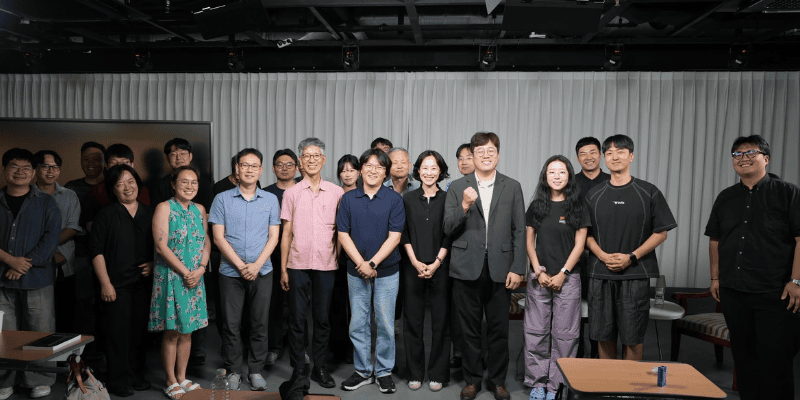
On 8 July 2026, around 65 theology students, professors and other guests gathered at Yonsei University in Seoul for a “book concert” celebrating the publication of Kyu-sik Ahn’s God Who Is Not, Yet Is: Dasŏk Ryu Young-mo’s Theology of Non-Being, published by Regnum Books (can be purchased here)
The gathering prompted a lively discussion about what it means to translate Korean theology for an international readership—and to move beyond a longstanding pattern in which theological ideas have travelled predominantly from the West to Korea.
Ahn’s book introduces English-language readers to Dasŏk Ryu Young-mo (1890–1981), a Korean Christian thinker who drew deeply upon East Asian traditions to reimagine some of the foundational concepts of Christian theology. Following the event, Regnum Books spoke with Kyu-sik about the challenges of translating not only words but an entire theological outlook, the response to the book in Korea, and the contribution Korean theology can make to the Church worldwide.
1. What does it mean to have your research published in English by Regnum?
Originally, when I published this book in Korean, my focus was on introducing Korean theology and spirituality to a domestic audience. However, presenting this to an English-speaking audience via Regnum required a shift in focus. The most symbolic change was altering the subtitle to highlight the concept of ‘Non-Being.’ I did not simply translate the text word-for-word. I omitted certain Korean linguistic wordplays that would lose their essence in translation and instead focused on the core theological messages. Having this work published by Regnum is deeply meaningful. It is not just a translation; it is an active invitation to Western readers to deconstruct familiar theological grammars and discover a broader horizon of World Christianity together.
2. What are the most significant aspects of Dasǒk Ryu Young-mo’s thought?
I believe the most valuable offering is his Theology of Non-Being, rooted in the East Asian concepts of Nothingness and Emptiness (Mu, Gong, Heo). Western theology has historically cantered on “Being,” equating God with immutability, perfection, and eternity, while often treating what falls outside human cognition as non-existent or weak. Dasǒk’s theology, conversely, is a ‘theology for those who are not.’ It recovers the marginalized — the ordinary, suffering people — not as passive recipients of salvation, but as active subjects. It offers a holistic view of cosmic redemption, where even the rice we eat is seen as sacrificing itself for us — a daily sacrament. Furthermore, it brings embodied East Asian spiritual elements like Body, Breath, and Qi (energy/dynamism) to the centre of Christian theology, offering an ecological and deeply relational pneumatology.
3. How would you describe the audience response and the atmosphere at the book concert?
The atmosphere was incredibly engaging, filled with intellectual curiosity. The audience was deeply challenged by the theological implications of translation. To give you a sense of the emotion, here are two memorable statements from the event:
A third-year Theology undergraduate commented: “Most of our textbooks have been translations of Western scholars, leading me to a vague bias that ‘real theology comes from the West.’ However, seeing the cultural clash in translating our theology into English was refreshing.
It was surprising to learn that while ‘Emptiness’ in the East implies openness and spaciousness, Nothingness’ in the West is often perceived as nihilism.
Translating Dasǒk’s concept not into a metaphysical ‘Existence and Non-existence,’ but into the poetic and paradoxical ‘God Who Is Not, Yet Is,’ made me realize how powerfully language shapes our thinking.”
- A guest panellist observed: “Translating Korean theology into global languages is not merely swapping words; it is creating a new theological grammar so that our spirituality is not misunderstood. This book shifts us from a church accustomed to ‘imported theology’ to one that must seriously consider ‘exported theology.’”
4. How does God Who Is Not, Yet Is contribute to theological conversations in an era of World Christianity?
I frame our current era as ‘Post-Christianity,’ standing at the intersection of Secularization and De-Westernization. First, I view current secularization not merely as religious apathy, but as a hidden thirst for a deeper, truer faith in the face of superficial religion. Dasǒk’s holistic salvation and embodied spirituality offer a compelling alternative for this thirst. Second, in terms of de-Westernization, we must construct theology in our own language from a de-colonial perspective. This is not about outdated nationalism, nor is it a reverse-Orientalism that sets Asia against the West. We should not present East Asian concepts merely as auxiliary supplementary data for Western theology. Korean theology has its own distinct grammar for explaining God’s salvation. I hope that by sharing this grammar, English-speaking readers will discover profound new spiritual insights and possibilities.
Kyu-sik Ahn’s God Who Is Not, Yet Is: Dasŏk Ryu Young-mo’s Theology of Non-Being is available to purchase direct from Regnum in print (£15) and eBook (£10) from the Regnum Books website by clicking here.